Supporting new music and up and coming artists is at the heart of Northampton Music Festival which is set to bring a day of free live music to the town centre on Sunday 19 June.
The festival will see 61 acts perform across eight locations throughout the town centre, with genres from rock to opera, world music to jazz and more.
Festival Director Graham Roberts said: “I’ve been a part of the music industry for more than 35 years as both a performer, teacher and as director of Northampton Music Festival for the past five years. I’m passionate that new artists should be supported and given professional practice through the experience of taking part in a festival, together with the challenge of playing to a large audience, possibly for the first time. Feedback from previous festivals show that this free entry festival is of great benefit to both artists and the general public who may not otherwise be in a position to afford to attend a large live music event. The increased footfall has also benefited the town centre, the whole purpose of the festival!”
Blackjack
Kerrie Cosh, Presenter of BBC Music Introducing in Northampton, which was created to support unsigned, undiscovered and under the radar musicians, has worked with the festival to curate part of the line-up of the Main Stage on the Market Square.
Kerrie said: “We are delighted to be working with Northampton Music Festival once again to showcase a wide range of talent from within our county. Northampton is a melting pot of diverse and multi-talented artists – and we’re always discovering new musicians we’re desperate to share with music lovers. We can’t wait to bring that energy to the Market Square stage this year.”
Sarpa Salpa
Headlining the Main Stage will be Northampton-based band Sarpa Salpa – a band that has been championed by BBC Introducing. The band first performed at Northampton Music Festival on the BBC Introducing stage in 2018 and, with their current single ‘Dreaming’ receiving critical acclaim, they have now progressed to headlining the entire festival.
Sarpa Salpa frontman Marcus Marooth said: “Having grown up in Northampton, I always used to look out for all the events we could try and get a slot for and festivals were always top of the list! There are some fantastic festivals in Northampton that we’ve been lucky enough to play at, and to be invited to headline NMF22 is really great! We can’t wait to get out there and give it everything we’ve got!”
New and emerging talent will also be celebrated on the Student Showcase Stage in Element Courtyard on George’s Row with performances from students at Northampton College and the University of Northampton.
Sarah Thursby, Curriculum Manager for Music and Performing Arts at Northampton College, said: “Being part of Northampton Music Festival is an important experience for our students and an insight into life in the music industry and the reality of a large-scale event. We go through a rigorous audition process to select the acts who will perform on the day and for many of the students the festival will be their first professional and, importantly, their first paid gig. For both Northampton College and the university students, the chance to collaborate and represent the growing talent in our town is essential. Supporting the music community, events and profession in Northampton is at the heart of what we do.”
Northampton Music Festival takes place from 11.30am until 9pm on Sunday 19 June, throughout the town centre.
For more information, and to receive news and updates on the acts performing, follow #NMF22 on social media on Facebook @northamptonmusicfestival, Instagram @NNmusicfestival and Twitter @FestNN.
God Save the People: When will Black lives matter?
“As they plundered, exploited and brutally controlled colonies and the people in them, all to enrich Britain as part of the growth of the capitalist project, colonialists swore by the racial hierarchy. Whiteness was not simply a descriptor; it was used to give anchor to the idea that Europe was the place of modernity and civilisation. White Europeans – in particular white upper-class men – were thought inherently modern and sophisticated; their black and brown counterparts, the opposite. The former, human; the latter, not. These ideas live on, subtly drawing a line between the developed and the developing, the advanced and the backward” – Maya Goodfellow, Hostile Environment
Introduction
In May 2022, community activist and Editor of The Happy HoodLaura Graham posted a video on Instagram (@ItsCharacterBuilding), essentially asking: how could organisations who had previously made Black Lives Matter solidarity statements (in 2020), now be validating the empire project in their support for the Queen’s Platinum Jubilee?
With the wealth of the Monarchy largely built from oppressing others, the recent long Jubilee Weekender represents a deep-rooted historical amnesia of an institution that still continues to take the public for fools. Following their ‘support’ at the COP26 conference, an investigation lead by the Independent found they also spent more than £13m of public money on private flights and helicopter journeys, also contributing massively to Britain’s carbon footprint. And while the present Cost-of-Living crisis will prove deadly for some, the revelation of a new £250m royal yacht described as a “floating embassy” adds insult to injury.
This exists in congruence to the fact foodbanks in the UK actually outnumber McDonald’s restaurants. Another symbol of British pride (the National Health Service), also exists while numbers of its staff are pushed to use these foodbanks. The blight of capitalism continues to violently oppress people in devastating ways, where colonial logics are tied to capitalist labour central to white supremacy – these discussions pervade through activist and advocacy circles linked to anti-racism, LGBT+ rights, the class struggle, disability justice and more. Yet, while street parties were in full swing, the Grenfell area held a street party where nobody attended with seventy-two empty seats for the victims of the 2016 tragedy. The Grenfell Inquiry is ongoing. In her op-ed for The Guardian, author-journalist Afua Hirsch also wrote “The platinum jubilee speaks to who we are now, which is obsessively consumption oriented, spending money we don’t have largely on credit. It is estimated that Britons will spend almost £1bn celebrating the bank holiday weekend, in spite of the rapidly advancing economic squeeze.”
Symbols can still cause harm. Just as things like the Nazi swastika are seen with horror and disgust (in most cases), I question why the symbols of the British Crown and colonialism are not unanimously met with the same horror and disgust.
“Kojo Karam explains the “Boomerang effect” of Empire. There is no binary between what happened “out there” to black and brown people and the insane levels of class inequality we experience in Britain. Everyone suffering economic injustice is at the mercy of the same system of privatisation, the weaponisation of the English legal system, offshoring and amnesia, among other phenomena- this is such an important book.”
Some may think the Jubilee was just harmless fun, bunting, and street parties, but it was about the practices and thinking that sit behind them. A culture and tradition of thought we have been taught to exemplify without thinking – while institutions that have implemented anti-racist commitments in the form of projects against the hostile environment (for example), were also supporting the Jubilee Weekend. But as academic Renée Landell said in an interview with Al-Jazeera, “The Windrush Scandal is a repetition of imperial violence that has caused a reckoning within ourselves, with the different generations rising up!” And Laura Graham’s video was really about demanding consistency from our institutions, standing by your words, and the ethics of supporting The Crown.
Speaking to Laura, she also told me: “If organisations are serious about their Black Lives Matter statements, they need to put their money where their mouth is. Those who have actively supported the Jubilee are telling Black and Brown people: ‘we didn’t mean what we said’. It’s time to think critically about the Monarchy. These aren’t harmless people pulling in tourists, they’re the personification of white supremacy and an ongoing legacy of racist colonial oppression.”
Symbols can still cause harm. Just as things like the Nazi swastika are seen with horror and disgust (in most cases), I question why the symbols of the British Crown and colonialism are not unanimously met with the same horror and disgust. Our education system has been so underfunded and bureaucratised to the extremes, few of us really know our own history (and despite being a historian, I am still learning all the time, as education is never finished). The state has run an enterprise of historical erasure par excellence! And symbols matter, as Renee Landell further states “even symbolic power is power because symbols give out messages to the world.”
Photo by Ehimetalor Akhere Unuabona on Unsplashed
So, this article will mainly discuss this historic institution in the context of Black Lives Matter in response to the numbers of organisations that made anti-racism solidarity statements in 2020 who then supported the Jubilee. However, I find it more useful to speak in terms of institutions not individuals so that is what I will be doing. This will also largely speak from the context of enslavement of people of African descent and its legacy. This is not to erase others who were also victimised, but to keep it streamlined (and this article is most certainly an introduction, not complete or by any means definitive). Lots of organisations that that made statements showed support for an institution that for centuries has viewed Black lives as less than human. I highlight Laura’s video because it represents the baseline I expect from white people and white organisations in their allyship (if they aim to be allies). When you have spheres of influence, use them responsibly.
While the Monarchy is also an inherently classist institution and discriminates against other marginalised groups, these recent celebrations also arrived after the anti-colonial backlash to the royal visits earlier in the year. For centuries, the Crown has been instrumental in the subjugation of many nations that are now part of the Commonwealth in the Global South.
As journalist Nadine White also tweeted: “Interesting commentary about the “beautiful portrayal” of multicultural Britain on the BBC. Royal author Robert Hardman credits the Queen with uniting the “extraordinary tapestry of nations” that is the Commonwealth. The Commonwealth is largely comprised of former British colonies. Many were already united, bonded, by the trauma of that experience.”
Moreover, it is also worth further thinking about how the act of ‘owning enslaved people’ as Corinne Fowler notes “… involved 6% of the British population (those who show up in the emancipation records).” Nonetheless, empire was challenged at every point both. For example, Priyamvada Gopal in Insurgent Empirealso discusses the Indian Rebellion of 1857, while in Mutiny at the MarginsAndrea Major and Crispin Bates further state:
“Despite the enduring myth of a nineteenth-century Pax Britannica, British rule in India and across the empire was punctuated by revolts, rebellions, insurrection and instability. So endemic were such challenges to British imperial rule that the events of the so-called Indian Mutiny of 1857 have been described as ‘unique only in their scale’.”
The Argument
Under the empire project, British enslavement for example was entwined with institutionalising white supremacy to a devastating effecting – inconvenient details and facts of history often pushed to the margins of polite conversation (yes, other countries enslaved, but here I am turning the critique inward to Britain). The role of the Monarchy has largely escaped criticism and it is time that changed, especially following the toppling of enslaver Edward Colston who was employed by the Royal African Company [RAC] – the largest human trafficking company in the history of ‘colonial’ enslavement. Now two years on, after the Black Lives Matter protests, many organisations came out in solidarity with the Monarchy who have been implicated in white supremacy since at least the 17th century. Meanwhile, King Charles II (the equivalent of the RAC’s CEO) stands atop All Saints Church. Have a think!
Seemingly, organisations care more for a national holiday, a pint in the sunshine, and white British pride than they do for standing by their commitments to equality. Although many organisations made “commitments”, it appears those solidarity statements were dependent on political convenience. Historical amnesia does not begin to describe it. As historian Shashi Tharoor said in 2017, “There is so much historical amnesia about what the British Empire really entailed. The fact that you don’t really teach colonial history in your schools. […] There is no real awareness of the atrocities.”
As I go to venues I have loved since childhood, I am now forced to question the ethics of accountability with organisations who postured anti-racism commitments but are now supporting an institution that is structurally positioned against the lives of Black people and other marginalised groups. Walking through Northampton seeing local fascination with the Crown collectively expressed in consciousness through posters and bunting etc etc – this also undermines the anti-racism statements many made two summers ago. However, it must be said that the funding of many Black and Brown groups (especially when funding is so insecure) can sometimes be contingent on their support of such “symbols” of Britishness (the rules of engagement aren’t the same for them).
Northamptonshire Rights & Equality Council CEO Anjona Roy told me: “Some of the anti-racist language is easier for white communities to accept than others. The lack of acceptance of empire as a violent oppressive construct intrinsically linked to murder, rape, slavery is a significant part of the problem. There are big institutions and huge amounts of capital that are dedicated to preserving the Monarchy and generally the status quo. All this colossal machinery makes the pivoting from Black Lives Matter to celebrating the Jubilee unsurprising.”
Some of the anti-racist language is easier for white communities to accept than others
Northamptonshire Rights & Equality Council CEO Anjona Roy
Recently someone called me “hypercritical” for asking questions of our institutions in the way I do. They further described me as “anti-Britain” and that “you should leave if you don’t like it” This is an example of a racial microaggression, where I know I am not alone in experiencing this. With conversations around the Windrush Scandal, as well as the Nationality and Borders Bill – such comments are racist and upsetting. I love this country (lots of my work is in British arts and humanities … I wouldn’t commit to that if I didn’t love something about it) but I do not share a love for establishmentarianism.
Growing up, it was interesting to observe that many people saw my dislike for monarchies and establishments as anti-white and anti-British. Through my work as a poet as well – where I have also critiqued British racism via conversations about patriotism and nationalism – I have been called “anti-Britain” because my work is open in its critiques. Of course, many organisations have hazy memories of the conversations that were being had in 2020. Nationally, we have a selective memory when it comes to the Monarchy. What happens when we call them monarchs rather than colonisers? The irony is, the violent history of the Monarchy also stretches further with violence against working-class people, including the white working-class in not just England but also Scotland, Ireland, and Wales. Most of us have common cause!
By the by, acceptance of such symbols of violence are more challenging not when it comes from strangers, but when it comes from your friends – people that you trust(ed) who were posting black squares now dazzled by the white gaze. And ‘liberal’ white organisations that celebrated their own “doing” of anti-racism, now can’t see how their support of the Monarchy comes at the cost of the Black and Brown people who are still dying in numbers from the legacies colonialism left behind: capitalism, the emotional impact of racial trauma in media, the hostile environment, police terrorism – the list is endless, cost of living is high, and Black Lives Matter is trending again.
Reading the work of historians, journalists, and other thinkers, I found much writing that shows why organisations that postured anti-racism statements should think twice before supporting the Monarchy wholescale. At the beginning of one of the most important books about Black British history Staying Power(ironically by a white man Peter Fryer), he discusses Elizabeth I’s working relationship with John Hawkins. The National Archives also speaks of how Elizabeth “assisted early merchant adventurers in 1561 by supplying ships and provisions […]” With this ‘success’, the National Archives also say the Queen saw “the economic value of … overseas trade [granting] a patent to eight merchants … to trade exclusively with Senegambia, between the Senegal and Gambia rivers, for a 10-year period.” This represents a sort-of relationship England (at least) had with Africans before it start trafficking Black Africans across the Atlantic.
Furthermore, Afua Hirsch’s book Brit(ish)in-part discusses a history of Britain that has largely been erased from popular public consciousness implicating the late Tudor queen in how the English came to be in the “business” of human trafficking:
“From 1562, when Sir John Hawkins began the industrial-scale exploitation of Africans, transporting Britain’s first ‘cargo’ … from West Africa to the Americas – a venture which so impressed Queen Elizabeth I she funded a return trip – every British monarch to George III gave his or her direct support to the transatlantic slave trade. The relationship between the monarchy and slavery was formalised in 1672 with King Charles II’s establishment of … the Royal African Company. It’s no exaggeration to say that the wealth of the royal family, much like the wealth of the nation itself, was built on the back of slavery and related trade, investment and industry.”
UCL’s ‘The Legacies of British Slavery’ database – curated by Catherine Hall and colleagues – also shows how enslavement was something everybody did, not just establishment classes. The work of scholars, novelist, poets, and other thinkers, including: Olivette Otele, Paul Gilroy, CLR James, Angela Saini, Eric Williams, Guilaine Kinouani, Akala, Walter Rodney, Katie Donington, Hilary Beckles, Andrea Levy, Roger Robinson, Sylvia Wynter, John Agard, Nick Draper, Onni Gust, Kerry Sinanan, Caroline Bressey and others are also vital to discussions about race/racism, colonialism, and / or enslavement. PhD students of history and other disciplines – including in the arts and social sciences as well – are doing great and important work, such as Renée Landell whom I mentioned earlier.
Thinking about representations of the Crown in the British imagination, this has been consumed by images of people like Elizabeth I as separate from colonialism and racial thinking (not instrumental parts of it). Though as Santham Senghera writes in Empireland“… it was Queen Elizabeth I who granted the East India Company a royal charter and lent to slave trader John Hawkins her own vessel ‘specifically for the purpose of capturing Africans on the West African coast …” Through my work as a poet-historian, I am simultaneously met with amazement and sometimes violence when I inform people of the horrors committed in the name of The Crown. The irony is not the conservative people who unabashedly support the Monarchy, but the numbers of people who I know identify as socialist, but support them too!
Amid the Queen’s Jubilee, particularly “white British people as white British people” are able to see themselves included within the regalia of bunting and union jack confetti. As spectacular as her 70th anniversary might appear, this is not a win. While the patron saint of England Saint George is reportedly of Turkish heritage, specifically the red and white flag itself has been repurposed by far-right groups such as Britain First and the English Defence League. Events such as royal occasions and England’s international football matches are a tough time for me – with punters mixing alcohol and patriotism / nationalism amid – of course – the usual racism that follows.
During the Euro final, Northampton was no different to the rest of this country on losing against Italy. However, the things I love most about Northampton is its diversity and that people from different parts of the world have chosen to call this place home. It reminds me how things like diaspora have shaped what it means to be Northamptonian. For example, my great-grandparents Toile and Edison Noel arrived in the early 1960s, whose lives like many Caribbean elders were shaped by the colonial and postcolonial experience. Yet, due to this sort of Britishness not being wrapped in red, white, and blue and because this history isn’t justifying colonialism or kissing the feet of the Crown or Churchill, this Britishness is not seen as love for country.
I was grateful that the Black Lives Matter protests on Abington Street in June 2020 was a multiracial protest and not being exclusively lead by Black people. In our anti-racism boycotting the Monarchy is a base requirement, considering its history of systematic exclusion and contemporary realities of racism (including against Meghan Markle). Moreover, the Royal Family’s 1960s colour bar for management positions, further to ‘excusing’ themselves from the Equality Act 2010. This contemporary culture at the palace reflects a historical reality where the same people who the palace now excludes, were also historically viewed by The Crown as less than human. By the by, following anti-colonial uprisings in the Caribbean to the royal visits, I was troubled by Jubilee celebrations lead by organisations that previously made anti-racism statements. Here, Ngugi wa Thiong’o’s Decolonising the Mindis so relevant as institutions appear paralysed by colonised thinking.
During a pandemic that has devastated business (especially independent), I appreciate they are stuck between a rock and a hard place. However, the backhanded replies I have received from larger local organisations when I challenged them on their pro-Monarchy position could only be described as what George Yancy implies as ‘white denial.’ It is not about whether these organisations have investment from the Monarchy (economic or otherwise), but whether these organisations are investing in the Monarchy (especially socially and culturally). This summer coming, I feel will be long and arduous for the white, Black, and Brown practitioners who try to be consistent in their work. In a UK post-Sewell Report (that claimed there was no evidence of institutional racism in the UK), convincing organisations that were already shaky on anti-racism that the Monarchy is violent will be challenging still.
In his article ‘Queen Victoria’s Maharajas: An Introduction’, Northampton historian Josh West gives a further insight into how Britain managed to control India for nearly two hundred years:
“Following the [1857] Rebellion, the East India Company had proven its ineptitude at governing such an important possession as India. To maintain control and ensure India’s riches remained in British hands, Parliament passed the Government of India Act on 2 August 1858; it liquidated the East India Company and transferred all its property, assets, land, and functions to the crown. India was now the possession of Queen Victoria and the British government, beginning a new era called the British Raj.”
How can we decolonise anything when we have yet to decolonise ourselves? West’s comment revisits the Monarchy’s investment in empire, and Shashi Tharoor’s book Inglorious Empireis a good starting point to learn about Britain’s relationship with India. The saying went the sun never set on the British Empire because at one point, the British Empire covered 25% of the world. On one side, I would love to exclusively blame under/miseducation for the widespread celebration of the coloniser-in-chief (it would be much easier if it was only this), but we must also consider how critical thinking is not really taught in schools – the tools to challenge systems that simultaneously harm us and govern our lives. And really, are systems of oppression going to give you the tools to liberate yourself?
In the same year the Colston Four were acquitted by a public jury, the public celebrates another symbol of white supremacy. His statue was not put there until 1895 (over one hundred and fifty years after he died). Despite people saying the Queen did not benefit from colonialism, her reign has overlapped with numerous events including the Mau Mau Uprisings, further to violent fights for independence intertwined with Caribbean Black Power Movements. A survivor of the Mau Mau Uprisings in Kenya, Muthoni Mathenge, wants compensation. This is not about the Queen as an individual, but what she represents and how these mechanics of violence endure.
Speaking to journalist Serena Richards, she told me: “If we think about the history of Britain, and the Monarchy, where most of their riches come due to colonisation, and colonialism, then there would be a lack of celebration and more of concern of what the Queen has done regarding giving back what was lost from these countries during her reign in the last seventy years.”
The Royal Family at the very least, as a starting point, should use their global platform to educate people about their involvement with slavery across several generations
University professor Corinne Fowler
The British Crown, however, is a constitutional monarchy, so, the Queen holds little power as an individual, yet the institution she represents is no less violent than the Church, policing, prisons, education, and others. We need to do more to educate others on the long-reaching history of Britain’s establishment institutions. The Crown is just one of them.
Local schoolteacher Tom Collins told me: “The culture war that we are engaged in, which is undoubtedly pervading state school life, wants to reclaim ideas of white supremacy related to the British Empire, the adulation of Churchill as a hero of WWII, and the worship of the Crown and the monarchy. People setting these agendas – the government civil servants writing the education white papers, designing curriculums, Ofsted, and education leaders as well as governors – are undoubtedly part of this process, and classroom teachers have very little say.”
Moreover, when I spoke to Corinne Fowler, she told me “The Royal Family at the very least, as a starting point, should use their global platform to educate people about their involvement with slavery across several generations.” In 2020, the university professor and Green Unpleasant Landauthor was also at the centre of an ‘anti-woke’ row amid the Government’s culture war after the publication of the National Trust’s report – an audit into many of their properties’ links with enslavement and colonialism which she co-authored with other academics.
Whilst many of us were taught about Queen Victoria and Churchill, what about juxtaposed histories of the working-class? Such examples include but are not limited to British Black Panthers, the Grunwick Strikes, the Chartists, and the Levellers. For the longest time when I was a child, I had assumed William Cuffay (the leader of the 18th century Chartist Movement) was a white man, when he was in fact Black. It is also very easy to talk about the present-day multiracial anti-racist movements as a new phenomenon, but they are not. In the 1970s the Anti-Nazi League was also multiracial, and in 1979, activist-schoolteacher Blair Peach was killed (most likely by the police) whilst at a rally in Southall demonstrating against the National Front. The Met’s policing of the demo impaired community relations in the area – and since 1979 the Met have been part of many incidents and shoddily-lead investigations including New Cross Fire (1981), the Murder of Stephen Lawrence (1993), the Death of Jean Charles de Menezes (2005), the Death of Ian Tomlinson (2006), and the Death of Mark Duggan (2011). Moreover, Child Q (2020) further explored in the 2022 report.
As a historian, I also do not pretend to know all. However, remaining curious is an underrated trait in pursuit of knowledge, a trait that is conditioned out of us as children. For all this country’s flag-waving, we not only know very little about present goings-on of The Crown, but also little about our own national story beyond the “official history.” Wandering these cobbled streets, I feel suffocated under the crushing presence of union jacks and St George’s flags, symbols of violence I associate with colonialism and the far right. To many white people (many who live in a country that has never really contested their right to Britishness) it may be harmless, but to me it is a reminder that I am unwelcome in this country (and town) and my Britishness comes with qualifiers. With bits of bunting flapping in the breeze, it is saying “Make Britain White” again. But the worst thing of all is when you see things like this accepted, condoned, and unchallenged by your friends.
Identified by Lord Macpherson in The Stephen Lawrence Inquiry, the practice of “institutional racism” goes back centuries. Queen Elizabeth I introduced the Royal Proclamation which could be cited as the second act of institutional racism on British soil, as historian Peter Fryer writes in Staying Power, she demanded “Blackamores be expelled from her kingdom.” Moreover, DeMontfort Students Union’s research into the knight Simon DeMontfort, also found the man DMU was named after was an anti-Semite – because in 1193, he expelled the Jews from Leicester City.
While I have named Elizabeth I, the Georgian and Victorian monarchs are also implicated in historic cases of inhumanity. In his 2016 book Black and British, historian David Olusoga writes: “Between the 1670s and the 1730s around … [150,000] men, women and children passed through [the Royal African Company’s] coastal fortresses on their way to lives of miserable slavery. […] The Royal African Company was a royal chartered monopoly and as such was able to call on the services of the Royal Navy to protect its monopoly, defend its fortresses and intercept the ships of so-called interlopers who attempted to muscle in on the trade. […]
Photo by Kristina Gadeikyte on Unsplash
The ‘Royal’ in the company’s title was not a mere honorific. Among the company’s founders were King Charles II and his brother James Duke of York, the future King James II … who was actively involved in its administration. […] So profitable were the activities of the Royal African Company that when in 1689, after he had been deposed in the Glorious Revolution and replaced with William of Orange and his wife Queen Mary, James II dispatched a representative to London to liquidate his shares, the former king’s profits amounted to £5,730 and were used to help fund his comfortable exile in Paris.”
From as early as the late Tudors in the 1560s we can see how the British Crown (thus establishments) sustained white supremacy in the trafficking of enslaved Africans (as well as sustaining other forms of racism in other parts of the empire). The emancipation of enslavement in the 1830s did not bring an end to empire, but saw Britain looking elsewhere, including India (thus the 1857 Indian Rebellion) and the African continent with the Scramble for Africa which saw a joint European colonisation of various parts of the continent.
You must hand it to the British state, brainwashing is their forte. With the long Jubilee weekend, however, I was upset to see numbers of organisations who were making anti-racism statements and posting black squares in the summer of 2020, now validating the empire itself – especially colleagues I held / hold in high esteem. I was very disappointed. This is an everlasting reminder of not just the legacies of colonialism but also the economic violence, with Crown and government as feudalistic overlords of the working-class – where in 2016, during her speech opening parliament, the Crown via the Queen told us “to live within our means.”
Nonetheless, as someone that was very active that summer in 2020 (as many local activists also have been prior and since), I have been tested lately. When those that are supposed to be your friends and allies are supporting institutions that are structurally against your existence, it gets very awkward. If you are a monarchist and / or your organisation is pro-Monarchy, by all means stand your ground and by your values. However, do not try to be these things while also posturing black squares and hopping on anti-racism hashtags. For institutions to pontificate about their anti-racist work while supporting the Monarchy in a Cost of Living crisis, that’s too far … and I must ask who is measuring your commitments to equality – Dr Strangelove, Thanos, and Darth Vader?
Conclusions
If the conversations you were having on Black Lives Matter in 2020 did not radicalise you, I must ask what conversations you were having? You can’t talk about anti-racism without also talking about the climate emergency (for example) and anti-capitalism, where ‘ownership’ is fundamental to whiteness as Cheryl Harris writes (thus, whiteness is fundamental to the establishment). So, if you are even remotely pro-equality, I would ask you think about your stance on the Monarchy as an institution (as for example, according to a Freedom of Information request done by the Independent, the Queen asked to use a state poverty fund to heat the royal palaces).
While we must not lay blame on individuals, we must also ask what sort of country we are if we are still talking about the Monarchy in 2022? No less than its legacies implicated in colonialism, economic extraction, white supremacy, exclusion, elitism and more. The fight against racism is also a fight against capitalism, including wealth-hoarders and inherited colonial wealth. To be anti-racist we must also be anti-capitalist (fundamental to other social justice movements including LGBT+ rights, class, climate, and disability justice).
The way we think about colonialism needs to change from a ‘historical relic’ into something that is ongoing and very much alive. My maternal family come from Grenada, a country that wasn’t independent until 1974 – where through the 1960s and 1970s many countries were in independence struggles. Between the 1950s and 1970s, the British state was also part of Operation Legacy which saw them hide and destroy colonial documents to stop them falling into the hands of now “independent” nations. Author-schoolteacher Jeffrey Boakye writes about this further in his book Musical Truth. Colonialism is not over. The legacies colonialism left behind still live to cause harm. We need to imagine a better fairer world and having a contextual knowledge about the history of resistance in Britain and elsewhere is a starting point to understanding our current situation. As Reap the Forgotten Harvestauthor Remi Kapo said: “If you look back in history (and we’re still repeating that history), the price of change has always been paid in blood.”
Towcester Food Festival – the area’s biggest, summertime, gastronomic extravaganza – returns to a fanfare this weekend.
The show is a celebration of artisan food and drink and boasts over 60 stall holders, many of them local to Northamptonshire.
As well as the stalls, there are outdoor bars selling local ale and cider, a street food market hosted by Bite Street NN, chef demos, cheese masterclasses and kids cookery.
Founder Crispin Slee said: “We literally cannot wait to throw the doors open again and welcome everyone back to the festival.
“Tickets are flying and it looks like the weather might be kind which would be a real bonus.
“It’s just so good to be back. Summer in Towcester just isn’t the same without the food festival.”
Towcester Food Festival takes place at Towcester Racecourse this weekend on Saturday June 11 and Sunday June 12, opening at 10am on each day. Parking is free.
The event was put on hold for two years during the pandemic but the organisers are delighted to be staging the annual event again.
Founder Crispin Slee said: “We’re looking forward to welcoming everyone to Towcester Racecourse once more for the highlight of the culinary calendar.
“The show is a bit smaller than it has been in previous years because many producers disappeared during the pandemic but there’s still plenty to sink your teeth into.”
Stalls ring the racecourse in large, open-fronted marquees and in the centre of the show is a live music lawn. There is jazz each morning and acoustic music in the afternoons with a performance by Towcester Rock Choir on Sunday afternoon.
Everyone is trying to stay sensible about this. After defeats home and away to Leicester Tigers during the normal run of the season Saints must now go to Welford Road for the Premiership play-off semi-final.
Tigers have not lost at home during this record-breaking campaign and have finished top of the table every round.
Saints season has been a story of picking themselves up from ninth and putting together an extraordinary run of games to now be in contention.
New signing Aaron Hinkley is enjoying the buzz of being involved at such a high octane moment.
“Where I’m from the derby was Gloucester – Bath. It’s like that. It’s good to be part of a game with some bite. You can feel it revving up in the squad during the week. We are peaking at the right time. We can’t wait,” he said.
“When I got put on loan to Coventry I was thinking about retiring. I wasn’t enjoying my rugby, I wasn’t enjoying my life much. To be here now is incredible and to manage to get a place in the squad at this stage of the season is unbelievable. It’s a good brand of rugby, it’s good to be around a team that is so proactive about the way they play. I’m just pleased to be part of it.”
Both East Midlands sides have been through a transition in recent years. Steve Borthwick got a grip of Tigers and had them doubling down on their traditional strengths: brutal uncompromising defence and clinical set piece opening doors for some world class talent in the backs.
Chris Boyd’s mission with Saints has been about harvesting the potential of the club’s youth. On the dark days it gets called ‘risky rugby’ but when it goes right Saints are one of the most exciting sides to watch in the Premiership.
At the moment the difference between the sides encapsulates one of the great debates about how rugby should be played. It used to be said that a ‘fancy dan’ southern hemisphere ‘ball through the hands’ style rugby wouldn’t work in the northern hemisphere. Our winters were too wet to promote ball handling skills. English rugby was just too good at trucking it up into contact, recycling and smashing on another six yards and then another, to really invest in another way.
Leicester beat Northampton 26-55 at Franklin’s Gardens and 35-20 at Welford Road
But things have been changing. The laws now seek to support speedy rucking. At the top of the tree Eddie Jones has been looking for internationals who can play a fast, sophisticated game. The current champions are Harlequins, a team with the ball-playing ethos at their heart.
At the start of his time in charge Chris Boyd said coaches had to find a way to win against teams that fielded 15 big units and it is some measure of his success that Saints are now in the position that they are.
Phil Dowson, who will be heading up the coaching team when Boyd leaves, is pleased with the way the team has responded to the challenges they have faced.
He said: “It feels pretty special. We have worked hard to give ourselves an opportunity in the semi-final and it works out that it’s a local derby as well. We have put a run together because of the position we found ourselves in. It’s clear as day when you are sat in ninth that you need to start winning some games and that put a little bit of pressure on us. The players have responded in a brilliant way, some of our performances have been excellent. We’re in a situation now where we can have a crack at it.
“We have got some trust and belief and confidence in the group. We have got trust and belief and confidence in the way we want to play. I think that is clear from the way we are playing.”
The comprehensive nature of Tiger’s results against Saints this season in some ways makes it a simple coaching message this week: get better at everything.
“We’ve taken a hiding twice,” said Dowson “They have been chastening experiences, particularly in the local derby. We have to learn the lessons from that. I think it’s clear as day in terms of getting our game on the field and dealing with their very aggressive and very dominant performances, how we get into the game and get our game on the pitch is integral to the success of our gameplan.
“It’s the way you want to play the game, the way you want to defend, the way you want to deal with mauls, the way you want to maul and attack. I don’t think it is any different to playing any other teams. We had to be physical against Quins in different ways. We had to be physical against Saracens in different ways and at times we weren’t physical enough and they rolled us over.
“It is the same every week. We have to be physical and disciplined whether you are playing, Gloucester, Newcastle or whatever. If you are on your own five a lot you are going to concede and Leicester are particularly good at that. We have to make sure that within our own systems, within our game, we are right on the edge.
“We have to be better across the board. We have to be better at set piece and winning the ball, better at the breakdown in terms of keeping hold of it and better at using the ball and being more clinical with opportunities to score.”
The view of Franklin’s Gardens from my mum’s dinner table in Norfolk at 3pm yesterday was not great.
I had warned her there would be a distraction during our visit. The fact that we were sitting down to eat just as the game was kicking off was nobody’s fault, it was more a product of the haphazard informality of a trip to my mum’s.
“Shall we go to my mum’s on Jubilee weekend? Yeah why not. Shall we eat now? Yeah, why not…”
So there we were, three generations of Scoleses, coalescing around a cottage pie and/or a lasagne (my mum couldn’t decide which to cook so produced both, homemade) as Northampton set out to confirm their place in the fantastic four that would be competing for the Premiership title in the next fortnight.
Tom Wood brought on the match ball after announcing his retirement this week
My mum doesn’t even have BT Sport but I have an app on my phone. I toyed with the idea of resisting the temptation but I realised, as I pondered how choosing between lasagne and cottage pie was a bit like choosing between picking Ludlam or Augustus at 8, that this wouldn’t be possible.
The answer was clear. Start with the cottage pie and then bring on the the lasagne for a strong finish, and maybe just have a peek at the phone screen now and then.
So around 3.04pmish with just a succulent dollop of mince, mash and carrots on my plate Matavesi broke through like an unexpected cherry tomato in the Cottage Pie mix.
“Matavesi’s broken through!” I announced to everyone at the table as I stared down into my lap.
“What?” my mum’s grip tightened on her serving spatula and she side-eyed the doors as she went into home defence mode.
“He’s scored!” I reassured her and apologetically brought my phone out into full view.
At this point I decided to explain Saints’ season to my mum, and then recent seasons, the whole Chris Boyd era, Saints’ longer history and the way the TV pundits never really take us seriously and the fact that Northampton doesn’t have city status and is constantly overlooked despite being a town that could eat a lot of these goddamned so called cities whole…
Soon enough there was cottage pie and lasagne on the same plate just like I always knew there would be and Saints were attacking the space like they were at a space cowboy rodeo.
The score as the Neapolitan Cheesecake and Tiramisu came out was 36-7 to Saints.
“That’s a lot of points,” my dad said, who seemed to be teetering on the brink of not knowing what all the fuss was about.
The team that could have really taken it all away from us, Gloucester (who have had an immense season) were 27-0 up at London’s filthy rich Saracens (who didn’t field their stars). It was perfectly possible that this could still go wrong. If Newcastle had won the second half, and they did claw back 19 points, that would have been it.
We call the alchohol, caffeine and sugar hit that is Tiramisu ‘fighting cake’ in our house and I chose not to opt for that. I instead went for the fusion of taste influences that was the Neapolitan Cheesecake garnished with a summery hat trick of strawberry, ice cream and thick double cream.
This was very much the way the game went as Newcastle had a man red-carded for head on head dangerous play while Saints unleashed their backs into the space created by his absence.
Tommy Freeman provided the summery hat trick while while the Newcastle fighting cake managed a creditable four tries. However Saints had scored ten so shove that up your pre-season predictions rugby pundits.
This win earns Saints a semi-final at Welford Road against our derby rivals Leicester, unbeaten at home this season. They beat us there and I can still see Steve Borthwick glowering over the Gardens at the final whistle after Tigers put 55 points on us in answer to our 26 at home.
No-one will deny we badly owe them a proper demonstration of what this team is really capable of.
As the media gears up for Northampton versus Newcastle on Saturday the pundits are all talking about it being Dean Richard’s last game in charge of the Falcons.
The former England star is a rugby legend in his own right and in the words of his opposite number at Saints, Chris Boyd “he is a good man”.
But at Franklin’s Gardens an equally emotional story will be unfolding for the home side. A raft of 15 players will be saying farewell to the supporters (including talismanic Tom Wood) and Boyd himself will be taking his leave after four years developing a side with a shot at emulating the feats of past greats.
A win against Newcastle will see Saints through to the play-offs with the mouth-watering prospect of a match against derby rivals Leicester waiting for them. Boyd the professional is determined to “stay in the moment” and focus on Saturday but he wouldn’t be human if he didn’t find himself reflecting on his time at the Gardens.
He said: “The biggest thing that I notice even watching training today when I first came here Dan Biggar was having to shoulder a lot of responsibility for talking on the field and holding guys to account. There was Tom Wood and Alex Waller but Dan Biggar was a very big part of it.
“I watched with interest today in training he is able to concentrate on running the game a lot more because of the emergence of players like George Furbank, Fraser Dingwall, Lewis Ludlam, Alex Coles, Alex Mitchell, Jimmy Grayson… those guys were all academy players when I came here and they have all taken a bit of time to find themselves in the environment and find their voice.
“Those guys have taken over collectively a lot of driving of things in the organisation and that has freed the burden of Dan Biggar and allowed him to drive the game and have a profound influence on the environment.
“Lewis Ludlam nearly didn’t make the chop when I first arrived but it became pretty apparent that he had genuine leadership ability. He speaks well, he speaks from the heart and he calls a spade a shovel. The emergence of him and taking control of that part of our game. He is a good listener as well as a good talker. That mature leadership is in really good hands. If those guys are still here in five years time there will be a great core of good rugby players and really good men because they are all bloody good blokes.”
Apart from the perennial Premiership coach’s problem of never being able to field what he might consider his best side, Boyd has enjoyed his stewardship of the Saints.
“Covid has been the only negative of my time here. We didn’t make as much progress as quickly as I would have liked. Covid aside I love Franklin’s Gardens, I love the stadium, love the people,” he said.
Newcastle is one of those sides that Saints have found it tough to put away in recent encounters and in no sense is a win seen as a foregone conclusion by the home side.
Mani Iyogun is one of the young breakthrough players that have energised Saints and the feeling in the squad is that they want to draw strength from the buzz of a full stadium.
He said: “We are definitely not looking past the Newcastle game, if we lose it we the ball is not in our court any more. We are still focussed and in the race. The boys have planned for a packed out stadium, it’s going to be really emotional occasion and we are going to use that.”
Matty Proctor, who helped Saints snatch vital bonus points with a spectacular diving score against Sarries last week, said the end of the season had been a “rollercoaster”.
He said: “We have had some ups and downs. We have had a couple of close games that we lost. To claw our way back into the top four is nice. We are quite proud of the way we were able to end that Saracens game and pick up those two bonus points.
“It’s cool. It’s a good challenge for us. We obviously have to win. It would be good to see how we perform under pressure but if we do what we are best at, we will be fine.
“There are a lot of close boys that are leaving. It’s been a bit tough. Some of their families have already gone but what better send-off than a win.”
With Her Majesty’s rugby press gathered to discuss Tom Wood’s retirement there was only one person missing – Tom was still out on the pitch training.
In no sense is this legendary Saints player winding down in the last few weeks of his 12th and final season both as a Saintsman and a rugby player.
If there is a chance he can play some part in whatever lies ahead for Saints in the next few weeks he is determined to be ready for it.
The dislocated shoulder that has kept him on the sidelines is very much on the mend and although is he not quite ready to pull the shirt on this week, if needed he would answer the call.
It is precisely that kind of grit that has made him such a favourite at Franklin’s Gardens.
He said: “When I was on the pitch last year I played well. The two injuries that have happened could have happened to anyone anytime. I had a dislocated shoulder and a stud go through a boot into my toe. It is not the sort of thing you could prepare for.
“I had surgery on the shoulder, it went well and I am just on the cusp of coming back. I don’t know whether the team can buy me enough time to feature this season but I am training as though I am going to be in the final and scoring the winner. That’s the plan.”
Tom Wood
With 50 caps for England and 240 for Saints there are plenty of career highlights to choose from.
Without doubt Saints fans memories will go back to the semi-final against Leicester when Tom scored a try that seemed to cause the whole town to erupt in celebration.
“This is the first time in my whole career I have had time to reflect,” Tom said “I remember by debut, the East Midlands derby, sun was out, immaculate pitch and I actually got Man of the Match, sorry about that. Whether I deserved it I don’t know because Tonga’uiha and Chris Ashton were on fire that day as well.
“Then there was the semi-final win, the East Midlands derby at home, having been nearly men we went on to win the European against Bath in Cardiff and of course the final went to 100 minutes against Sarries. That was probably the stand out month of my career, it stands out as the peak of my personal and the teams journey. Hopefully there is more to come. Obviously my England debut, beating the All Blacks in 2012, huge occasions.
“I came here really excited as a 23-year-old from Worcester in 2010. I saw the energy they had in this team. I learned so much, had such a great time. Beyond the team itself, the club and community welcomed me with open arms. It’s a rugby town. I’ve settled in and my kids are in school here. I’m here to stay. I can’t thank the club and town enough really.
“My closest mates, Mikey Heywood, Courtney Lawes and Alex Waller are in the same boat. I feel like an adopted child of Northampton or have become one. With the way the game is going, the business side of things, it is getting harder and harder to be a one club man.”
Tom Wood
Tom’s plans for the future involve going into business with team mate Alex Waller.
“I am a qualified tree surgeon. Myself and Alex Waller have officially joined up together now, a combination of joinery and tree surgery. I am a full time redneck that plays part time rugby,” said Tom.
“I was always into woodwork in school but when I got into rugby I went away from it a bit because I am kind of an obsessive personality. I had a bit of time away with an injury in 2012 and I started to pick up a few things. As I got more space I got more kit and as a hobby it just grew and grew.”
Tom is facing life after rugby with the same focus and application he showed on the pitch but does admit to a little emotion at the end of an era.
“Already it is fairly overwhelming with the support and congratulations and well wishers. I made my peace with retiring probably last year. I have been thinking about it. It has been on the backburner for a while that the reality was fast approaching.
“I have been planning in the background what is going to come after rugby. It has not been too much of a shock but you can’t help but feel a little bit saddened that this part of your life is over.
“I try not to worry too much about what could have been different. I don’t have any regrets or bad feelings.
“My parting message to the boys would be, this flies by, you have got to be prepared and take every opportunity that comes your way. You have got to have another mission after rugby too. It is not just about making money, it is finding something to get up for. You can’t replace the highs and lows but you have got to have something to get excited about.”
The full line-up for Northampton Music Festival has been revealed, with 61 acts set to perform in eight locations throughout the town centre.
The free music festival, which takes place on Sunday 19 June, kicks off at 11.30am on the Main Stage in Market Square with Northamptonshire school children performing Katy Perry’s Fireworks in sign language and culminates with a homecoming headline set from Northampton-based band Sarpa Salpa, whose new single ‘Dreaming’ is receiving critical acclaim.
TBone Afrika Allstars
The World Music stage, in the courtyard of The Guildhall, will see a headline performance from T Bone Afrika Allstars – formed just a few months ago, the band is already playing to packed audiences across the country conjuring up the sense and feel of Africa. Northampton’s own Ivor Johnson Band, rooted in soul and gospel music, will play an array of instruments from around the world. Sandeep Raval, curator of the World Music Stage, said: “This is an amazing opportunity for the Northampton community to experience world class talent on their doorstep for free.”
Headlining the classical stage, in its new home at Northampton Museum’s Courtyard, will be esteemed musicians David Blackadder and Richard Holloway. David is one of the world’s finest trumpeters who was hand-picked to play at the wedding of Prince Harry and Meghan Markle. Richard is one of Northamptonshire’s most respected and admired pianists who has dedicated much of his life to inspiring students at NMPAT.
Alex Clarke
The Jazz Stage at the Guildhall Hotel will be headlined by the Alex Clarke Duo. One of the most in-demand and versatile young saxophonists on the British jazz scene, Alex won the Rising Star category of the 2019 British Jazz Awards and was a finalist in the BBC Young Jazz Musician of the Year competition in 2020.
The New Boots stage at The Black Prince on Abington Square will see folk-rock flair for the headline performance from Northampton singer Aryah and her group.
New and emerging talent will be celebrated on the Student Showcase Stage in Element Courtyard on George’s Row with performances from students at Northampton College and the University of Northampton.
Kate Coyle
Two pop-up stages have been added to the line-up, both in memory of local musicians Pop Spencer and Kate Coyle who recently passed away. Gelda Spencer, Pop’s wife, said: “Music was such a big part of Pop’s life and he loved performing at the local festivals in Northampton. He would be so proud of this tribute to him at Northampton Music Festival.”
Pop Spencer
Kate’s friend, Scott Walters, said: “Kate was an amazingly talented singer and ukulele player and her favourite places to play were The Black Prince, The Mailcoach and The Fish. Kate was loved by so many.” Pop-up curator Hannah Faulkner was determined to remember both much loved local performers during NMF22.
The full line-up of the festival is:
MARKET SQUARE – MAIN STAGE
11.30am: SIGNING Stars
12pm: Wellingborough Gospel Choir
1pm: Richard Exall’s Shooting Stars
2pm: Mystic Crew
3pm: Hana Brooks
3.30pm: Gabriel Halford and Dave Crawford
4pm: Sharmaine
5pm: Lay it Down
6pm: Phantom Isle
7pm: Pure Genius
8pm Sarpa Salpa
GUILDHALL COURTYARD – WORLD MUSIC STAGE
1pm: Durgesh and Friends
2pm: Inta Africa
3pm: Paul Jackson
4pm: Brazilian Vibes
4.30pm: Plastic Visual
5pm: The Ivor Johnson Band
6pm: TBone Afrika Allstars
(Followed by a spectacular finale featuring all acts)
GUILDHALL HOTEL – JAZZ STAGE
1pm: Elle Delaney and Co
2pm: Dan Wyllie Quartet
3pm: The Krupa Connection
4pm: Day-Hood & Co
5pm: Wayne Matthews Trio
6pm: Alex Clarke Duo
NORTHAMPTON MUSEUM COURTYARD – CLASSICAL STAGE
12.30pm: Joshua S Bell
1.30pm: Kay Warçaba
2.30pm: Wellingborough Gospel Choir
3.30pm: Rob Colley
4.30pm: David Blackadder and Richard Holloway
THE BLACK PRINCE – NEW BOOTS STAGE
1pm: Chargr
2pm: Jasmine Burns
3pm: hazeyjane
4pm: In Atoms
5pm: Paul Ronney Angel
6pm: Aryah
ELEMENT COURTYARD – STUDENT SHOWCASE STAGE
12.45pm: The Stencil Pencils
1pm: Tabitha Brown
1.20pm: Sophie & Daisy
1.40pm: Katakuris
2pm: Matt Jones
2.20pm: xtahc
2.40pm: New Age Jam
3.10pm: Plastic Visual
3.30pm: Thrifted
4pm: Back2Basics
4.30pm: Mitsäu
5pm: One Way Ticket
5.30pm: Our Condolences
6pm: Osmium_band_
6.30pm: Worth a Shot
POP-UP STAGE OUTSIDE V&B (ST GILES’ SQUARE) – A TRIBUTE TO POP SPENCER
12pm: Niamh Keating
12.50pm: Ant & Luke
1.40pm: Mae Stephens
2.30pm: Hannah Faulkner
3.20pm: Marc Checkley
4.10pm: Charlie Tarry
5.10pm: Jake Brown
POP-UP STAGE ON FISH STREET – A TRIBUTE TO KATE COYLE
12pm: Andreas Rose
1pm: Michael Green
2pm: Scott Walters
3pm: Tom Cayton
4pm: Joseph Boyle
5pm: Ray Beck
For more information, and to receive news and updates on the acts performing, follow #NMF22 on social media on Facebook @northamptonmusicfestival, Instagram @NNmusicfestival and Twitter @FestNN.
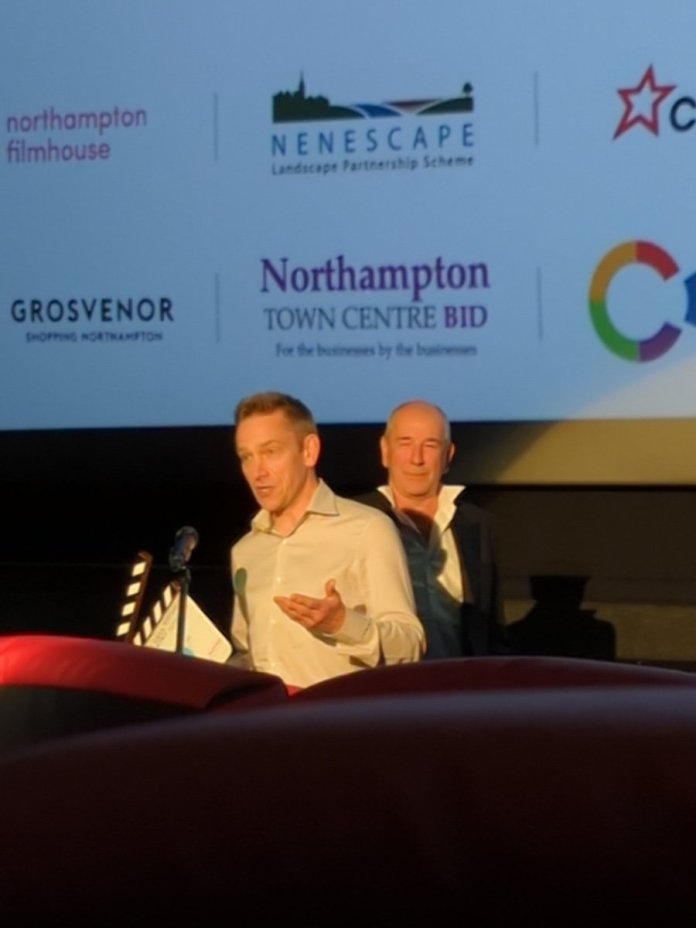
The third Northampton Film Festival rounded off a week of events last night with an awards ceremony at Sixfields Cineworld which celebrated upcoming movie talent in and around Northampton.
Compered by NLive radio’s Dr Audrey Tang, guests were welcomed to the ceremony and screening of the winners by Becky Adams of Screen Northants who described the event as “the East Midlands Oscars”.
Cineworld had even laid on a red carpet outside the cinema as participants arrived in dinner jackets and evening wear.
Schools
Runner up: Leo Kelly of Northampton College for Hope
Winner: Duston Eldean Primary for Covid A Child’s Perspective
16 and Under
Winner: Oscar Myles with No Time to Explain
Best Documentary
Runner up: Jay Martin with Red to Blue
Winner: Catherine Rose with A Life Worth Living
Best Drama
Runner up: Hope by Leo Kelly and Keep Off The Grass by Tyla Sharp
Winner: Swing by Marcus Thomas Anthony
Sketchy Link to Northampton
Runner up: A Change In Time by Pat Knight
Winner: Tyrannosaur and The Secret Garden by Joey Lever
48 Hr Challenge
Winner: Connor Mclean
Our social media coverage courtesy of @nosylocaljourno:
Best drama is Swing by Marcus Thomas Anthony (don’t trust my spelling on these, I’m winging it)
Next up is ‘best link to Northampton’
Winner is Steve Price
Here’s Steve!
Winner of winners prize for 48hr film challenge is presented by @ScreenNorthants boss Becky Adams to Connor MacLean (who is a previous winner and gets plaudits from every judge). 👏